Architecture
Two gRPC surfaces, one address
nereid binds a single address (server.bind_addr) and serves two gRPC services on it:
inference.Nereid— nereid's own service:HealthCheck,ViewModels, and the streamingCheckpointinference RPC.inference.GRPCInferenceService— the KServe v2 gRPC surface, an open inference-protocol standard. nereid vendors the proto verbatim, so any KServe v2 speaker — a stocktritonclientincluded — can drive it unchanged (see KServe v2 compatibility).
They aren't two systems. Both are backed by the same models and the same ModelManager; they're
just two front doors into it.
The ModelManager
At startup the server reads nereid.yaml and builds a ModelManager that owns every configured
model. For each one it:
- Resolves the model folder under
server.ml_backends_path. - Works out the backend from what's in the folder, or honors an explicit
backend:in the config (see Backends). - Hands the folder to that backend to load — creating a virtualenv, loading a
.ptinto libtorch, opening an ONNX Runtime session — and reads the model'smodel_inference.textprotocontract. - Stores the loaded backend alongside its contract and a bounded pool of request permits, and logs which backend, at which version, is serving the model.
If any model can't be prepared — a missing file, a bad contract, a backend the server wasn't built with — startup fails with an actionable error instead of coming up with a broken model in it. This is one place where being strict is clearly right: a server that starts happily and then fails on the first real request has just moved the problem somewhere much less convenient.
Backpressure
Each model gets a semaphore with queue_capacity permits. A request takes a permit, runs the
blocking backend off the async runtime, and gives the permit back when it's done; if no permit is
available, the call is rejected right away with ResourceExhausted.
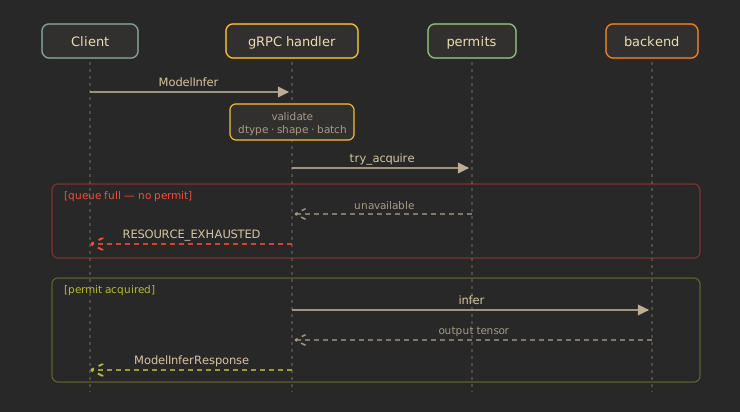
So nereid sheds load rather than growing a backlog it has no real intention of getting through. That's the more useful behavior for a client that is going to retry anyway: a fast rejection is information, while a queue that keeps accepting work just converts overload into latency and hides it. The subprocess backends get this for free, since the same permit bounds how many child processes a model can have running at once.
Request lifecycle
ModelInfer(KServe v2, unary + streaming). The richest path: single- and multi-tensor, the full KServe dtype set. The handler checks the request datatype against the model's declared datatype, normalizes the batch dimension, builds the input tensors, takes a permit, and streams the typed output back.Nereid/Checkpoint(streaming). nereid's own path: the client streams a tensor in chunks, the server validates it, runs the model, and streams the output tensor back. A backend can also provide a richer stream — the Python backend uses this to interleave the model's stdout and stderr as log chunks while it runs.
Backend dispatch
Everything above is backend-agnostic. The core talks to one Backend trait — a platform()
string, a blocking infer(), and an optional checkpoint_stream() — and never asks what kind of
engine is on the other side. Tensors cross that boundary as raw bytes plus a shape and a dtype,
rather than as any one framework's tensor type, which is what keeps the trait from quietly
becoming libtorch-shaped.
The backends aren't listed anywhere in the core either. Each one lives in its own folder under
src/backends/, registers itself at link time, and is discovered by the build; the core just
iterates those registrations to detect and load. Adding a backend means implementing the trait and
dropping in a folder, and the gRPC surfaces don't change at all. Backends walks
through what goes in that folder.