nereid-server
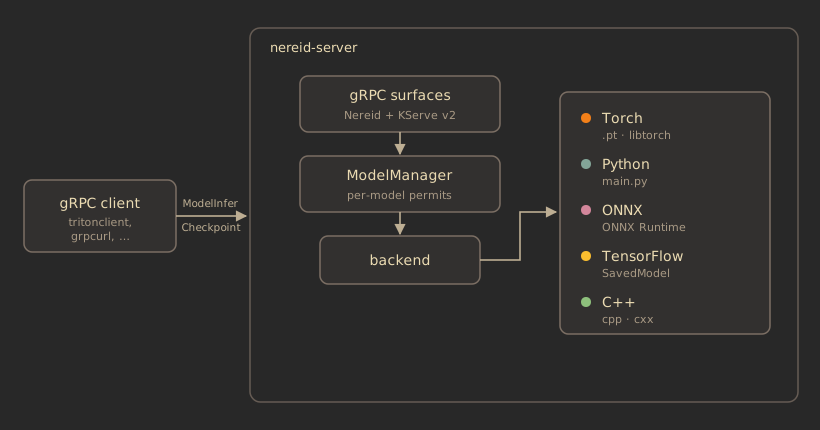
A nifty little Rust inference server. nereid reads a config file, loads the models you list in it,
and serves them over gRPC — both its own native Nereid service and the standard KServe v2 gRPC
surface on the same address, so any KServe v2 client (a stock tritonclient included) can drive it
without changing a line of client code.
How a model actually runs is the job of a backend. Backends are self-contained and self-registering, so the server core has no idea which ones exist, and you compile in only the ones you want.
At a glance
What to read next
- Install — the dnf repository, what the packages lay down, and getting the service running.
- Architecture — the two gRPC surfaces, the
ModelManager, how requests are bounded, and how one gets to a backend. - Backends — the backends that ship today, how the server finds them, and how you add one of your own.
- Model contract — what goes in a model folder, what
model_inference.textprotosays, the batching rules, and the subprocess tensor contract. - KServe v2 compatibility — how nereid speaks KServe v2 on the wire, which RPCs are implemented, and how to check that for yourself.
- Building & running —
build.sh, the libtorch dependency, linking modes, HPC builds, and choosing your backends. - AI-generated code — how AI tools are used in developing nereid, and the review policy applied to every change.
Core ideas
- Config-driven.
nereid.yamllists the models to expose, each model's device, and how many requests it will hold at once. If a model isn't in the config, it isn't served. - Folder-per-model. Every model is a directory under
server.ml_backends_path, and the server works out its backend from what's in the folder (or from an explicitbackend:in the config). - Speaks the KServe v2 standard. The
inference.GRPCInferenceServicesurface is vendored from the KServe v2 spec, so what goes over the wire is byte-compatible with any client of it. See KServe v2 compatibility. - Backends are discovered, not listed. Each one lives in its own folder and registers itself at link time, so nothing in the core enumerates them, and adding a backend doesn't mean editing the core. An ONNX-only build links no libtorch at all.